 Abracadabramoney
 cauldrons let borrowers preview MIM debt before committing eligible collateral
Abracadabramoney cauldrons support borrowing Magic Internet Money (MIM) when eligible assets can remain locked as collateral. A simple borrow delivers MIM to the wallet while an eligible interest-bearing token can continue earning yield. Before committing, the position preview shows projected debt and a liquidation price. Borrowing serves a need for liquidity only while the collateral requirements, borrowing costs and repayment funding remain workable.
Supported deleveraging uses collateral sales to repay MIM debt, giving up some asset exposure as the loan shrinks.
A loan preview before committing collateral
The position preview shows how selected collateral and borrowing amounts would affect the loan before its opening transaction completes. It includes collateral value, MIM to repay and the liquidation price. The repayment figure includes the mint fee, so it can exceed the MIM the borrower receives. Changing a proposed amount changes the projection; it doesn't create debt.
Collateral losses and liquidation risk
A falling collateral value raises the debt-to-collateral ratio when the MIM debt stays unchanged. That relationship determines how much room remains before liquidation eligibility.
The collateral ratio divides outstanding MIM debt by the collateral's dollar value. A lower ratio means more collateral supports the debt. The ratio can rise through a loss of collateral value or an increase in debt, so an unchanged token balance doesn't establish unchanged loan health.
Each cauldron sets its own Maximum Collateral Ratio (MCR). A position becomes eligible for liquidation when its ratio exceeds that threshold. The maximum marks a solvency boundary; it doesn't provide an operating buffer against falling collateral value or growing debt. Borrowing close to the limit leaves less room for either change.
Yield production and collateral value can move differently. An interest-bearing asset can continue earning yield while losing market value. Continued yield therefore doesn't establish that a position remains below its liquidation threshold.
Liquidation allows a liquidator to repay eligible debt in exchange for collateral. The liquidation fee also comes from the borrower's collateral. A later price recovery doesn't restore collateral already transferred through liquidation, which can interrupt an intended period of holding the asset.
Collateral eligibility and available borrowing capacity
A usable cauldron must accept the intended collateral on the selected network and have enough MIM available for the proposed borrow.
Eligibility and availability answer separate questions: an accepted asset doesn't establish how much MIM the market can currently supply. Each isolated position also has its own liquidation assessment. Extra collateral in another position doesn't automatically support this loan. Positions in different cauldrons can have different borrowing terms, and each needs sufficient backing for its own debt. The wallet's combined asset value isn't the collateral ratio of every loan it holds. A listed market can therefore be unsuitable for a particular borrowing amount even when the collateral qualifies.
Retaining an interest-bearing asset while accessing MIM
Borrowing against an eligible interest-bearing token provides access to MIM without requiring an initial sale of that collateral. The token can continue earning yield while it secures the debt.
The borrower retains exposure to the committed collateral and takes on a repayment obligation. The economic comparison with selling includes both asset performance and borrowing costs. A configured opening fee adds to debt. Interest-bearing debt can then grow during the holding period, so collateral yield doesn't establish a positive net return after those costs. Borrowing also leaves the asset exposed to liquidation. Retaining exposure to the token doesn't guarantee retaining the original collateral balance through the planned holding period.
The transaction that establishes the loan
The simple borrowing flow combines depositing collateral and borrowing MIM in its final transaction. Preliminary approvals can precede it. The resulting debt and collateral entries identify the open position, while the borrowed MIM reaches the wallet. The commitment begins with the completed borrowing transaction, not with an amount selected in the preview.
BentoBox and DegenBox provide token-vault infrastructure underlying cauldrons. Vault balances and position balances represent different accounting records. A wallet signature, a vault balance and a cauldron debt balance consequently establish different facts. When assessing whether funds remain freely available, the relevant distinction is whether the asset backs an outstanding loan.
Partial repayment and collateral adjustments
Partial repayment reduces outstanding debt without necessarily ending the position, letting the borrower retain collateral exposure. The repay interface supports custom repayment and collateral-removal amounts. Those choices work together: removing collateral at the same time can offset some of the improvement from repaying MIM.
Additional collateral lowers the ratio when it increases the backing for unchanged debt. Borrowing more raises the ratio when collateral value stays unchanged. Further borrowing and collateral removal remain subject to solvency checks. A partial repayment doesn't automatically make all remaining collateral withdrawable; the outstanding debt still constrains removal.
An open position during a pause in activity
An outstanding loan continues under its market terms when the borrower stops interacting with the interface. Where the market charges interest, debt can keep increasing over time. Collateral value can also change during that interval, affecting liquidation eligibility. Waiting therefore differs from leaving an unsubmitted preview unchanged. An open loan remains exposed to those changes while any debt remains outstanding.
Leverage for increased collateral exposure
Leverage uses borrowed MIM to acquire additional collateral and return it to the position, increasing exposure to the collateral asset. The leverage route doesn't deliver spendable MIM to the wallet. A need for wallet liquidity therefore points to simple borrowing; a leveraged position pursues a different output and carries greater exposure to collateral losses.
The documented leverage mechanism combines its borrowing, acquisition and collateral-deposit operations within one transaction. Failure of a required operation causes that transaction to fail. Successful execution still leaves a collateral-backed debt position. Swap execution introduces price impact and slippage alongside the cauldron's borrowing constraints, so a valid collateral ratio alone doesn't determine whether the leveraged opening can execute.
Repayment funding and the limits of unwinding
Ordinary repayment uses MIM to reduce the loan, making repayment funding part of the decision to borrow. Spending the borrowed tokens doesn't reduce the recorded debt. A wallet-funded exit requires enough MIM to settle the outstanding amount, including applicable fees and accrued interest. Repayment and collateral withdrawal can share the closing transaction.
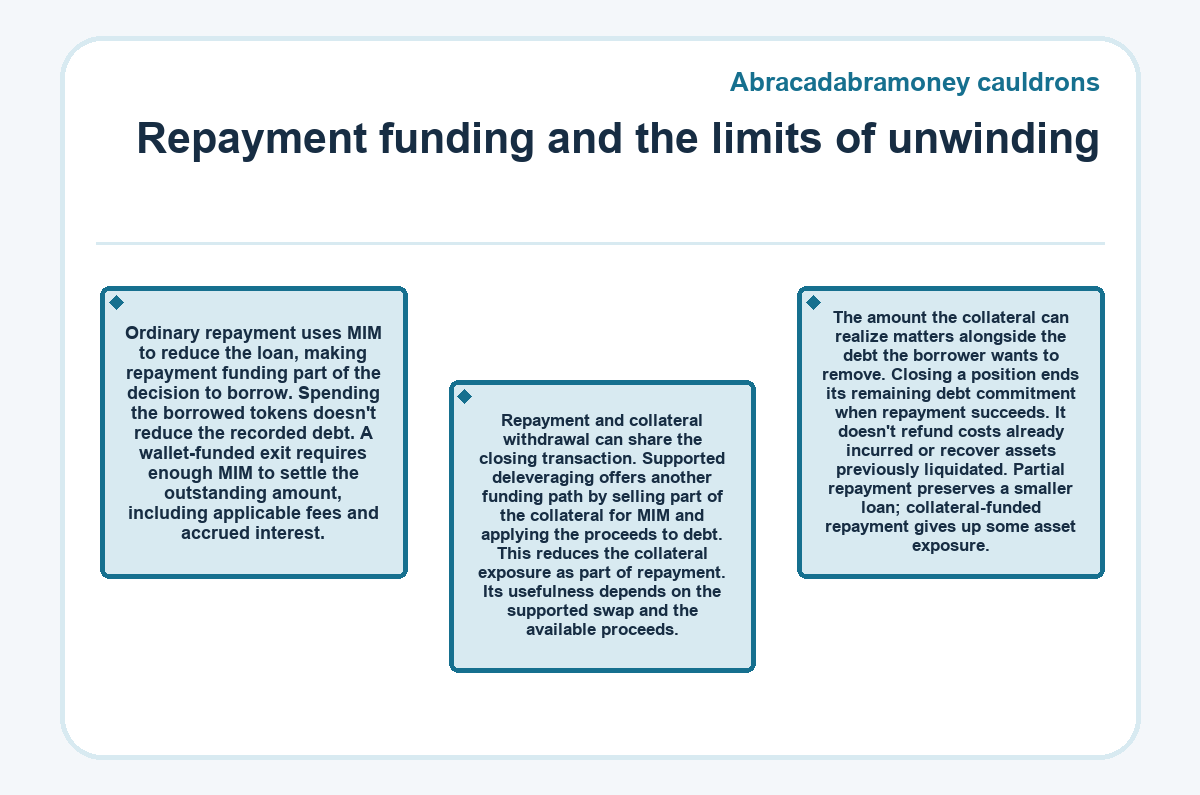
Supported deleveraging offers another funding path by selling part of the collateral for MIM and applying the proceeds to debt. This reduces the collateral exposure as part of repayment. Its usefulness depends on the supported swap and the available proceeds. The amount the collateral can realize matters alongside the debt the borrower wants to remove.
Closing a position ends its remaining debt commitment when repayment succeeds. It doesn't refund costs already incurred or recover assets previously liquidated. Partial repayment preserves a smaller loan; collateral-funded repayment gives up some asset exposure.
Conditions for choosing a simple MIM borrow
A holder seeking spendable MIM while retaining an eligible interest-bearing asset can use simple borrowing to combine those aims. The fit depends on the asset remaining suitable collateral throughout the loan. Before opening that position, the relevant conditions are:
- The selected cauldron accepts the collateral on the intended network.
- Available MIM covers the proposed borrowing amount.
- Projected debt includes the applicable opening fee.
- The collateral ratio leaves room below the market's liquidation threshold.
- The intended exit has a workable source of repayment MIM.
The boundary between borrowing, holding and selling
Holding the asset without a cauldron loan fits a task that requires continued exposure or yield without borrowed liquidity. Selling serves a need for proceeds when retaining that collateral exposure isn't required. Neither choice creates the same combination of committed collateral and MIM debt. Borrowing becomes relevant when access to MIM and retention of eligible collateral are both part of the task.
Reward participation is a separate purpose. MIM income through mSPELL staking comes from protocol revenue, whereas cauldron MIM creates repayable debt. Opening a loan adds a liability to the asset position; it doesn't substitute for earning a staking reward. If the collateral must remain freely withdrawable, committing it to an outstanding cauldron loan conflicts with that requirement.
Abracadabramoney cauldrons: questions and answers
-
Does the opening fee apply again when I increase a CauldronV4 loan?
- CauldronV4 applies its configured opening fee to each additional borrowed amount. The contract adds that fee to the new debt rather than recalculating it against the entire existing loan. The parameter can change, so the relevant fee is the one applicable to the additional borrowing. This is a CauldronV4 behavior, not a fixed fee rate across all cauldrons.
-
Why can a CauldronV4 borrow fail when the market has available MIM?
- CauldronV4 checks both a market-wide debt cap and a per-address cap within that market. Available MIM alone doesn't establish room under either limit. The market cap applies to total MIM debt, while the per-address cap uses debt parts rather than a plain MIM amount. The proposed position must also satisfy the collateral requirements.
-
Is the liquidation price shown for the collateral or for MIM?
- The displayed liquidation price refers to the collateral securing the loan. It identifies the collateral-price boundary associated with liquidation risk for the projected position. MIM is the borrowed asset, so interpreting that figure as a trigger price for MIM would misread the preview. Changes to collateral or debt can change the displayed boundary.
-
Can a deleveraging swap leave MIM outside my wallet?
- A deleveraging swap can leave surplus MIM in DegenBox after repayment. The interface exposes that balance through My Positions for withdrawal to the wallet. A partial deleverage can leave both remaining debt and surplus MIM, so the vault balance and the debt figure describe different amounts. The wallet balance alone doesn't account for MIM still held in DegenBox.
-
Do all cauldrons accept both native and wrapped forms of collateral?
- Some cauldrons support a choice between a native coin and its wrapped form. That interface option belongs to the selected market and doesn't establish support across every cauldron. The accepted collateral remains a market-specific requirement, so possession of a related token with a similar name doesn't by itself establish eligibility for the intended loan.
-
Can I repay a cauldron by transferring MIM directly to its token vault?
- A plain MIM transfer to BentoBox or DegenBox doesn't perform a cauldron repayment and can cause a loss of funds. Repayment requires the appropriate contract operation to reduce the recorded debt. The repayment interface handles that operation; sending tokens to a contract address bypasses it.
Last updated -