 Abracadabramoney
 lets SPELL stakers choose SPELL or MIM rewards
Abracadabramoney offers SPELL staking through sSPELL for rewards in SPELL and mSPELL for claimable Magic Internet Money (MIM). sSPELL represents shares in a SPELL pool, with rewards reflected in the SPELL each share represents. mSPELL records a staking position and pays rewards in MIM. Both methods depend on protocol revenue, so choosing a reward asset doesn't establish a fixed return.
Jump to a section
sSPELL staking uses Ethereum mainnet, while mSPELL has separate deployments across supported networks. An mSPELL payout leaves the deposited SPELL principal in place, so choosing stablecoin rewards doesn't turn the entire stake into a stablecoin holding.
sSPELL tokens and mSPELL balances
A completed sSPELL stake creates pool-share tokens, while an mSPELL deposit records SPELL in a staking contract. These records represent different claims.
sSPELL pool shares
sSPELL is an ERC-20 token representing a share of pooled SPELL. Its token balance measures ownership in that pool; its conversion ratio expresses how much SPELL backs each share.
The token balance
Minting issues sSPELL against deposited SPELL at the prevailing pool ratio. The receipt-token count therefore needn't match the number of SPELL deposited. Existing shares don't multiply whenever the pool receives rewards.
The SPELL behind each share
Fee-funded SPELL added to the sSPELL pool without new share issuance increases the SPELL represented by each share. Redemption burns sSPELL and returns the corresponding SPELL at the pool's ratio.
mSPELL staking positions
mSPELL keeps a record of staked SPELL and separately accounts for MIM rewards. You don't receive an mSPELL receipt token to hold or transfer. A staking balance and a pending reward balance describe different assets within the same position.
Revenue sharing across the staking pools
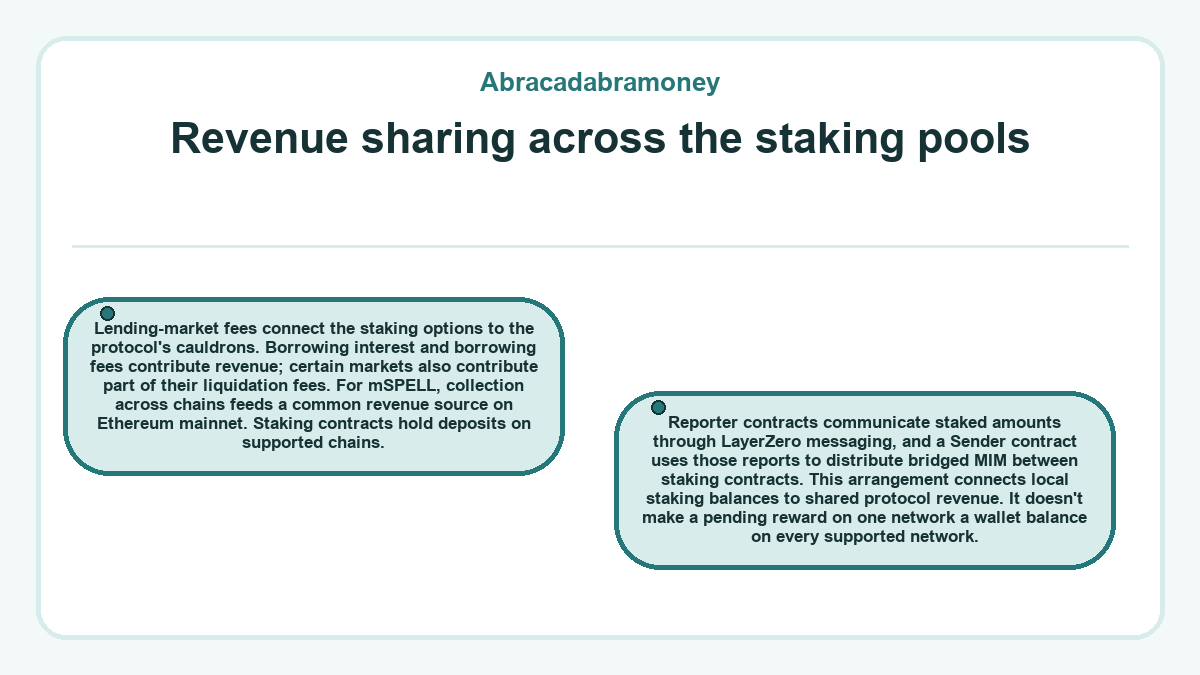
Lending-market fees connect the staking options to the protocol's cauldrons. Borrowing interest and borrowing fees contribute revenue; certain markets also contribute part of their liquidation fees. For mSPELL, collection across chains feeds a common revenue source on Ethereum mainnet. Staking contracts hold deposits on supported chains. Reporter contracts communicate staked amounts through LayerZero messaging, and a Sender contract uses those reports to distribute bridged MIM between staking contracts. This arrangement connects local staking balances to shared protocol revenue. It doesn't make a pending reward on one network a wallet balance on every supported network.
Ethereum staking and multichain token restrictions
sSPELL staking takes place on Ethereum mainnet. mSPELL has documented deployments on Ethereum, Arbitrum, Avalanche and Fantom Opera. Each deployment uses its own staking contract and accepted SPELL token. A shared ticker doesn't establish compatibility between a wallet asset and the token a particular contract accepts.
Legacy Multichain-wrapped SPELL and sSPELL carry bridge-related restrictions following the Multichain hack, with underlying funds locked on Ethereum. Native Ethereum SPELL and SPELL using Arbitrum's own bridge are distinct from those Multichain-wrapped representations. A historical deployment list doesn't establish usable backing for an affected bridged token. The network and token representation both matter when interpreting an existing position or considering a deposit.
A constant share balance with a changing SPELL entitlement
An unchanged sSPELL balance can leave a holder wondering whether rewards have accumulated. In this hypothetical example, the holding is 137 sSPELL. The initial ratio is 1.20 SPELL per sSPELL, and the later ratio is 1.25 SPELL per sSPELL. Assume no deposits, withdrawals or share transfers between those observations, and assume the position is eligible for redemption.
The underlying SPELL amount equals the share balance multiplied by SPELL per share. Initially,
137 * 1.20 = 164.4 SPELL
. At the later ratio,
137 * 1.25 = 171.25 SPELL
. The underlying entitlement has increased by 6.85 SPELL even though the wallet still holds 137 sSPELL.
The later ratio explains a gross redemption amount of 171.25 SPELL under these assumptions, before transaction costs. mSPELL rewards would instead appear as a separate MIM entitlement beside the SPELL stake. The example's ratio change supplies neither a dollar profit nor an estimate of mSPELL income.
Withdrawal locks and MIM claim eligibility
Staking locks control when SPELL can leave a position, and mSPELL's lock conditions also affect the collection of MIM rewards. sSPELL deposits start a 24-hour redemption lock. In mSPELL's documented lock-enabled arrangement, deposits prevent ordinary withdrawals and reward claims during the following 24 hours. That claim restriction qualifies the ability to collect pending MIM.
The mSPELL contract exposes a configurable lock setting, so the active deployment's configuration matters. A visible claim control doesn't override an applicable deposit lock. Claimable MIM must also exist; the expiry of a lock doesn't create a reward distribution or establish a payout amount.
APR estimates and transaction costs
The staking annual percentage rate (APR) uses the preceding 30 days of DAO revenue as its revenue basis. It varies with the economics of revenue sharing. An annualized estimate doesn't fix the SPELL or MIM a position will earn over a future period.
Reward comparisons need a common denomination and measurement period. An increase measured in SPELL isn't directly comparable with MIM income without accounting for token prices. sSPELL's compounding mechanism also differs from collecting MIM separately, so matching displayed percentages alone wouldn't establish identical outcomes.
Network transaction costs affect net returns and can be paid in a different asset from the reward. Collecting mSPELL rewards requires a transaction. sSPELL's pooled accounting incorporates added SPELL without a separate reward claim for each addition, although redemption still requires a transaction. More frequent MIM claims can therefore increase aggregate transaction costs.
SPELL exposure after choosing MIM rewards
The reward asset determines the form of income, while the staked asset determines the principal's token exposure. Choosing mSPELL leaves the principal in SPELL. Its market value can fall even while MIM rewards accrue. MIM itself is a collateral-backed stablecoin targeting the US dollar, and that target doesn't guarantee its market price. sSPELL suits the goal of accumulating SPELL through pool shares; mSPELL suits collecting the allocated revenue in MIM. Neither reward choice converts the whole position into a fixed dollar balance.
Before you start with Abracadabramoney
-
Can I transfer sSPELL immediately after staking?
- A fresh sSPELL stake on Ethereum mainnet locks outgoing transfers as well as redemption for 24 hours. The contract applies the lock to the sending account's sSPELL balance. Holding a receipt token therefore doesn't mean it can immediately move to another wallet, even though sSPELL otherwise follows the ERC-20 token model.
-
Do additional sSPELL deposits lock shares I already hold?
- Adding SPELL to the same Ethereum sSPELL staking account resets that account's lock to 24 hours after the new deposit. The updated lock also affects shares the account already held. It doesn't create a separate withdrawal timer for each batch of sSPELL minted, so an older balance can become locked again.
-
How does the staking method affect SPELL governance voting power?
- Both sSPELL and mSPELL staking count toward governance voting power, with one vote for each SPELL staked. Selecting MIM rewards doesn't inherently surrender that staking-based voting weight. The relevant unit is the underlying staked SPELL, so a raw sSPELL share count shouldn't be treated as an equal count of SPELL.
-
Is sending SPELL directly to a staking contract enough to earn rewards?
- A direct SPELL transfer doesn't perform the staking operation that records your entitlement. sSPELL requires its minting operation, and mSPELL requires a deposit recorded by its staking contract. A token transfer by itself supplies no corresponding share issuance or deposit record, and the transferred funds can be lost.
-
Does mSPELL income require taking out a MIM loan?
- mSPELL earns its MIM rewards from a SPELL staking deposit; opening a cauldron loan isn't a prerequisite. A MIM loan and a MIM staking reward have different accounting meanings. Borrowed MIM creates debt, while a staking reward represents an allocated share of protocol revenue.
-
When is pending mSPELL income available in my wallet?
- Pending MIM becomes wallet-held MIM when a successful claim transaction transfers it to the receiving account. A pending reward figure describes an unclaimed entitlement. Selecting Claim or signing a transaction doesn't by itself confirm delivery, and an applicable deposit lock can prevent the claim from completing.
Last updated -